The Conversation That Never Happens After the Match
Apr 11, 2026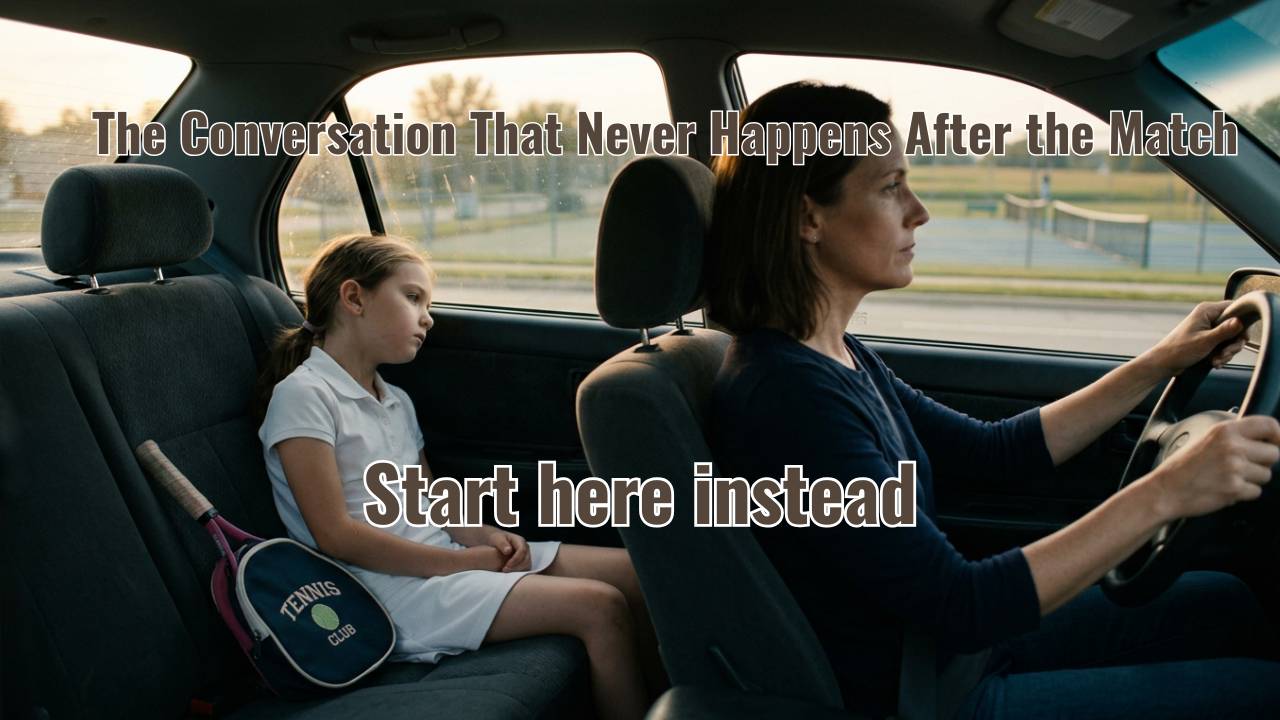
Saturday — April 11
You sit in the car after the match and wait for your child to say something. Sometimes they do. Most of the time they do not. You ask how it went and get a short answer. You try again and get less. At some point the conversation ends without ever really starting, and you drive home in a silence that feels like something failed without being able to say what.
If you have been around junior tennis long enough, this moment becomes familiar. There is no argument. No drama. Just a gap where something should have happened and did not.
Most parents interpret this one of two ways. Either their child is not thinking about what happened, or they are avoiding the conversation because they are upset. Both interpretations lead to the same response: the parent fills the silence. They explain what they saw. They point out the pattern. They identify the moment that cost the set and what should have been done instead. They are trying to help, and in almost every case they have seen the match more clearly than their child has.
Nothing changes.
The effort is real. The observation is often accurate. The problem is that the conversation you are trying to have is not one your child is equipped to participate in yet, and starting with your version of the match makes it harder, not easier, for them to access their own.
From where you were sitting, the match is something you watched. You saw patterns across multiple games. You saw what happened on the third point of the fourth game when the score was close and your child tightened. From where they were standing, the match was something they lived from inside it. It moved faster. The points that seemed obvious from the stands were not obvious from the baseline. What you watched unfold over ninety minutes was experienced by them as a sequence of moments with no pause between them.
When you open with explanation, you are asking your child to agree with a version of the match they did not experience the same way you did. Even when your analysis is correct, they cannot integrate it because it does not connect to anything they can still feel or remember. They nod. They agree. They move on. You interpret the agreement as understanding. The next match produces the same result and you do not know why.
There is a different way to open that changes what becomes possible.
The next time you are in that car, do not start with what you saw. Ask them one question about what they were trying to do. Pick a specific moment — not the most important one, just the one that stands out to you — and ask what they were trying to do in it. Not whether it worked. Not why it did not. What they were trying to do.
Then stop and wait.
If they say they do not know, ask what they remember about it. What they saw. What they expected to happen. Stay with their answer longer than feels comfortable, because the useful material usually comes after the first sentence, not in it. You are not trying to teach anything in this moment. You are trying to open a door that normally stays closed.
What you will find, if you try this consistently, is that your child has more access to their own experience than the silence suggested. They have been processing it. They just have not had a way into a conversation that starts from where they actually are instead of from where you can see them. When the question gives them that entry point, the conversation that follows is different in kind, not just in tone.
This is not the full solution. It is one shift that creates the conditions for a different kind of conversation. For some families, that shift is enough to change how matches get processed. For others, trying it reveals how much deeper the structural problem runs — because the missing conversation is not just in the car, it is built into how the entire development environment is organized.
If you have tried versions of this and nothing has moved, the issue is likely not how you are starting the conversation. It is that the conversation has nowhere to go once it starts, because the structure around it — the debrief, the loop, the way learning is supposed to accumulate over time — is not there. That is not a character problem. It is a design problem.
The Crossroads Audit was built for exactly that moment. It makes visible where the loop is breaking down in your specific situation: what is missing from the process, where your child's experience is getting replaced before it can be understood, and what would have to change for learning to start compounding instead of resetting after every match. If you want to see where the conversation is stopping, that is where to start.
Never Miss a Moment
Join the mailing list to ensure you stay up to date on all things real.
I hate SPAM too. I'll never sell your information.
